Operational Intelligence
Stop losing decisions, risks, and ownership between engineering reviews.
Information exists. Continuity does not. Decisions made, evidence gathered, direction agreed upon: none of it persists automatically between reviews. Symplex builds Program Memory: a persistent operational record so each review starts from the actual state of the program, not a reconstruction of the last one.

Engineering Coordination Needs Its Own Version Control
Before version control, software teams coordinated through memory, documentation discipline, and hope.
Version control did not make individual developers better engineers. It created a substrate that made the collective more reliable than any one person's memory. Engineering programs coordinate decisions, risks, and ownership the same way software once coordinated code: informally, and without a persistent record. Symplex starts at the engineering review meeting, where that coordination is generated and where it currently evaporates. The program doesn't start over. It continues.
Program Memory: a persistent operational record that survives staff changes, supplier transitions, and organizational restructuring.
“I'm not aware of another system that does all this.”
The Problem
Engineering organizations lose disproportionate time and execution confidence to coordination overhead, not technical uncertainty.
- Lost context. Decisions made in review meetings are not reliably translated into execution artifacts: the rationale behind them evaporates once the meeting ends.
- Disconnected decisions. What was decided in one review and what's being worked on downstream drift apart, with no link tying them back together.
- Ownership drift. Owners and due dates shift after cross-functional reviews, and no one can recall the original decision context.
- Repeated rediscovery. The same risks and blockers resurface meeting after meeting because no one tracked that they were already raised.
- Lack of traceability. Safety, validation, and systems dependencies are discovered too late, because decision impacts are never tracked downstream.
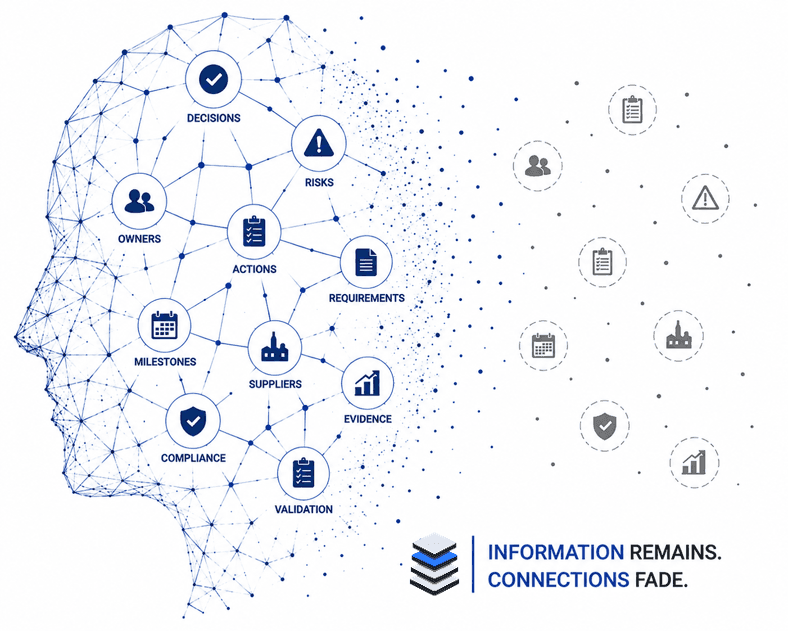
Programs accumulate coordination debt the same way software accumulates technical debt: invisibly, until it forces a costly correction.
Program complexity is compounding across software, electronics, safety, and systems integration faster than meetings, status reports, and individual memory can keep pace. The debt is invisible on a dashboard. It shows up as a missed dependency, a decision that has to be re-made because no one can locate the original rationale, or a new team member spending weeks reconstructing context that was already established. The tools most programs rely on were not built to carry decisions and ownership forward between reviews. That is why the debt compounds instead of clearing.
“I'm on a board call right now. This exact pain point keeps coming up, and nobody knows how to address it. Symplex Systems does.”
Who It's For
Engineering Program Leaders
- Every review starts by reconstructing where things stood last time, because decision rationale and open items live in memory, not in a record.
- Symplex carries that context forward automatically, so each review starts from the actual state of the program.
Directors and Executives
- Status reports say the program is on track right up until it isn't. The risk and decision history that would have shown otherwise was never visible.
- Symplex gives you direct, traceable visibility into decision history and risk accumulation. When teams reorganize, the program record survives the transition intact.
Cross-Functional Engineering Teams
- Ownership falls into the gaps between teams. A decision one group made gets re-debated by another because the rationale never traveled with it.
- Symplex attaches ownership and rationale to every decision as it crosses teams, so accountability holds even when the people in the room change.
“This system may allow a single PM, instead of managing two or three programs, maybe double the size of the programs he or she can manage.”
Works With What You Already Produce
Symplex does not require a new meeting format or a new tool in the room. It works from what your team already produces:
- Engineering review meetings
- Transcripts
- Meeting notes and documents (.txt, .md, .docx)
- Engineering review packages
- Text-layer PDFs
- Supporting program documentation
What Changes
Every item on the left has a named counterpart in Program Memory.
Before Symplex
- Ownership is unclear or disputed.
- Decisions get rediscovered instead of recalled.
- Executives chase status instead of seeing it.
- Review cycles repeat the same unresolved issues.
- Rationale stays buried in a transcript no one revisits.
- Downstream impacts are disconnected from the decisions that caused them.
After Symplex
- Ownership is attached to a named record and owner.
- Decision history is preserved and recalled, not rediscovered.
- Leadership reads from a current operational record.
- Open issues persist across reviews instead of resetting.
- Rationale stays attached to the source evidence that supports it.
- Downstream impacts stay linked to the decisions that caused them.
“Never really seen it fully implemented as something that was automatically cascading and updating, flagging issues, adding clarity, updating as things change.”
Built for Real Engineering Programs
Symplex is built directly from the structure of real engineering review workflows, not retrofitted onto a generic summarization tool. The focus is complex engineering programs where the cost of losing operational continuity is highest: automotive, advanced manufacturing, defense, robotics, and aerospace.
General-purpose AI tools summarize conversations. Symplex delivers Operational Intelligence. Those are different things. Summarization produces a record of what was said. Symplex produces a structured, evidence-backed Persistent Operational Record of what was decided, who owns it, what it affects downstream, and whether it has been resolved, carried forward across every session.
Summarization sees one meeting. Symplex sees the pattern across all of them: which risks keep recurring, which actions keep carrying forward, where ownership is unstable, and where decisions are churning.
Symplex is a working operational intelligence platform entering strategic-partner deployment.